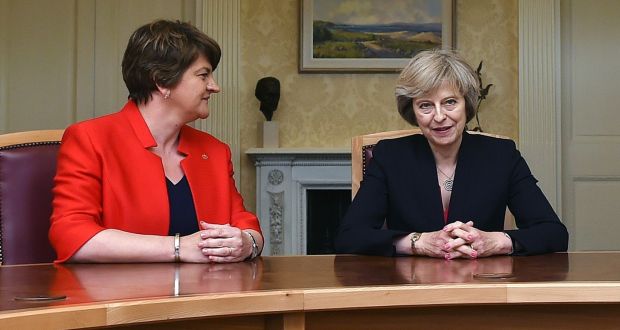
 When UK Prime Minister Theresa May recently called for a general election, her goal was to increase her party’s parliamentary majority, primarily to strengthen Westminster’s hand in Brexit negotiations, but also in the internal issue of Scottish—and potentially Welsh—secession from the union. The gamble backfired, with the Tories losing their slim majority, while still retaining the largest number of seats. What opportunities does this new configuration of power offer the GCC?
Hung parliaments—where no party has an overall majority—create a rare opportunity for small parties to wield disproportionately large influence in government. To form an effective government, the Tories must look to build a coalition to secure a majority, so that they can pass important legislation. The ideal partner will have two characteristics. First, it will be small in size, as this lowers the price that the Tories have to pay in order to “purchase” the acquiescence of the coalition partner, either in terms of ministerial positions, or favorable policies. Second, it will have similar policy positions to the Conservatives, again in an effort to lower the cost of securing the partner’s compliance. With these criteria in mind, May opted to build a coalition—and a small majority—with the Northern Irish Democratic Unionist Party. In general, Northern Ireland can look forward to an amplified role in UK politics for the foreseeable future, for two reasons. First, in the short term, the DUP’s pivotal role in the legislative process means that it forcibly has the ear of Westminster. For example, with the Conservatives favoring a path of economic austerity, which is strongly opposed by all other parties, the DUP can hold the cabinet to ransom over the budget. Second, in the long term, the anti-secessionist Tories were hoping to use a strong parliamentary majority to sweep aside calls for Scottish and possibly Welsh independence. Now that the UK is heading toward a period of uncertain government, including likely weak economic growth, it will be much harder for authorities to resist secession. The DUP, and Northern Ireland, however, are both strongly unionist, and wish to remain politically integrated with England under all circumstances, meaning that their relative power share is increasing. What does this imply for the GCC? Ever since the British arrived in the region during the early 19th century, the Gulf countries have had warm relations with the UK, and May’s December 2016 visit to the GCC, on the heels of the Brexit vote, underscored the mutual desire to enhance relations. The hung parliament alters the bargaining landscape. In particular, Northern Irish interests now have a larger role in determining UK interests, meaning that the GCC countries need to recalibrate their proposals accordingly. Thus, the first step for the Gulf countries should be to study what Northern Ireland wants, and what it can offer the GCC. Among the potential areas for cooperation are Northern Ireland’s manufacturing sector, which is still suffering from the global financial crisis and the subsequent economic tumult. As part of their economic visions, all the Gulf countries wish to improve their manufacturing, and partnerships with the Northern Irish can play a positive role, both in terms of capacity-building and knowledge-transfer. In fact, Northern Ireland has its own economic vision 2030, with many features in common with the Gulf visions, most notably the desire to strengthen the private sector, and to improve research and development. There is an explicit desire to improve scientific collaboration—an opportunity that the GCC countries should consider as they look to boost their own knowledge-production industries. Prior to the UK general election, experts estimated an 80% chance of a Tory majority. Global politics seems to be becoming less predictable. For the GCC countries to thrive, flexibility and adaptability are key; forging a close relationship with Northern Ireland could be the latest surprise.
0 Comments
Leave a Reply. |
Omar Al-Ubaydli
This is where you can find all my articles, as well as some of my interviews and media mentions Archives
June 2020
Categories
All
|
 RSS Feed